

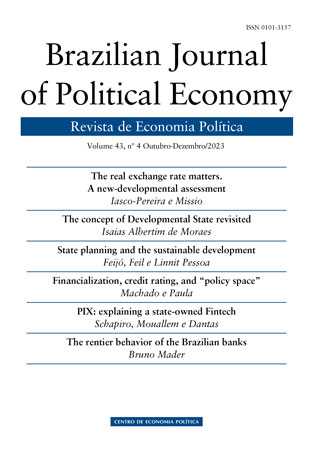
The rentier behavior of the Brazilian banks
Article Sidebar
Published:
Nov 16, 2023
Keywords:
Financialization spread banks interest rate markup
Main Article Content
Abstract
Brazil is an emblematic financialization case in which a high Selic interest
rate benefited financial institutions. However, the real Selic rate has historically declined,
becoming negative in 2020. As a result, one should expect banks’ incomes to be negatively
affected, yet this was not the case. Banks overcame this macroeconomic challenge by
increasing credit operations. Within this context, our study confirms that the increasing
credit spread income is inversely correlated to the declining Selic rate. Hence, we conclude
that banks have maintained a rentier behavior: security gains derived from the past high
Selic rate phase were replaced by a high spread charged to credit consumers.
JEL Classification: G00; E42; E43; E44; B50.
Downloads
Download data is not yet available.
Article Details
How to Cite
Mader, Bruno. 2023. “The Rentier Behavior of the Brazilian Banks”. Brazilian Journal of Political Economy 43 (4):893-913. https://doi.org/10.1590/0101-31572023-3457.
Section
Review