

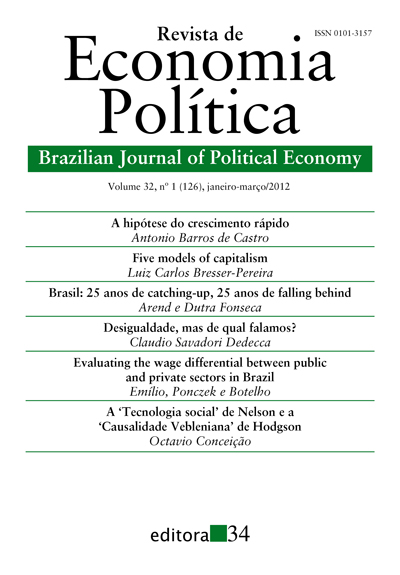
Brazil (1955-2005): 25 years of catching-up, 25 years of falling behind.
Article Sidebar
Main Article Content
Abstract
The present paper discusses the Brazilian industrial development under a neo-schumpeterian perspective in the period after 1955. The hypothesis is that, in the last 50 years, Brazil spent the first 25 years catching up and, next, the following 25 years falling behind. The 1955-1980 period, by means of international funding, allowed catching up with the paradigm in maturation within the fourth technological revolution. However, in this period, it was determined the main debilitating elements for the country's entrance in the new techno-economical paradigm of the fifth technological revolution which emerged in the middle of the 70s. It is in the strategy to internationalize the economy, granting the mutinational companies the key-sectors of the national economy dynamics during the catching up period, the main element of dependence in the journey that conditions the current performance, responsible for technology subordination and keeps the Brazilian economy with low dynamism.
JEL Classification: O14; O33; O54.