
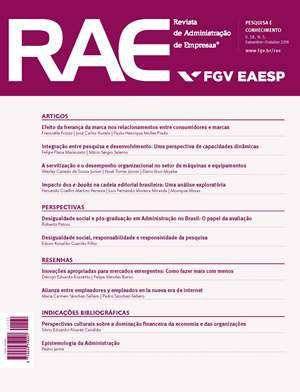
Servitization and organizational performance in the machinery and equipment sector
Article Sidebar
Main Article Content
Abstract
The role of manufacturing in value chains has become less dominant given the trend of stagnating demand, commoditization of products, and declining profitability. Confronted with this challenging scenario, a growing number of companies seek to add value to their businesses by adopting the approach of “servitization” (offering product-service solutions). However, literature on this subject is divided on the effectiveness of this approach since the intended outcome is not always achieved (service paradox). As such, this study quantitatively evaluates this relationship in manufacturing firms within the machinery and equipment industry. Data on different service categories developed by these firms and their corresponding impacts were collected. It was verified that there is a positive and significant relationship between the majority of these service categories and organizational performance, which indicates that identifying and developing a consistent service bundle may serve as an effective servitization strategy.
Downloads
Metrics
Article Details
A RAE compromete-se a contribuir com a proteção dos direitos intelectuais do autor. Nesse sentido:
- adota a licença Creative Commoms BY (CC-BY) em todos os textos que publica, exceto quando houver indicação de específicos detentores dos direitos autorais e patrimoniais;
- adota software de detecção de similaridades;
- adota ações de combate ao plagio e má conduta ética, alinhada às diretrizes do Committee on Publication Ethics (COPE)


References
Allmendinger, G., & Lombreglia, R. (2005, October). Four strategies for the age of smart services. Harvard Business Review, 83, 131-145.
Baines, T., Bigdeli, A. Z., Bustinza, O. F., Shi, V. G., Baldwin, J., & Ridgway, K. (2017). Servitization: Revisiting the state-of-the-art and research priorities. International Journal of Operations and Production Management, 37(2), 256-278.
Baines, T., & W. Lightfoot, H. (2013). Servitization of the manufacturing firm: Exploring the operations practices and technologies that deliver advanced services. International Journal of Operations & Production Management, 34(1), 2-35.
Bascavusoglu-Moreau, E., & Tether, B. (2011). Servitization, survival and productivity: A longitudinal study of UK manufacturing firms. DRUID 2011 – Innovation, Strategy, and Structure – Organizations, Institutions, Systems and Regions. Copenhagen, Denmark.
Benedettini, O., Swink, M., & Neely, A. (2017). Examining the influence of service additions on manufacturing firms' bankruptcy likelihood. Industrial Marketing Management, 60, 112-125.
Bikfalvi, A., Lay, G., Maloca, S., & Waser, B. R. (2013). Servitization and networking: Large-scale survey findings on product-related services. Service Business, 7(1), 61-82.
Brax, S. (2005). A manufacturer becoming service provider: Challenges and a paradox. Managing Service Quality: An International Journal, 15(2), 142-155.
Chin, W. W. (1998). The partial least squares approach to structural equation modeling. In Marcoulides, G. A. (Ed.). Modern methods for business research (pp. 295-358). Mahwah, USA: Lawrence Erlbaum Associates, Inc.
Cooper, D. R., & Schindler, P. S. (2016). Métodos de pesquisa em administração (12th ed.). Porto Alegre, RS: Editora Bookman.
Crozet, M., & Milet, E. (2017). Should everybody be in services? The effect of servitization on manufacturing firm performance. Journal of Economics & Management Strategy, 26(4), 820-841.
Floriani, D. E. (2010). O grau de internacionalização, as competências e o desempenho da PME brasileira. São Paulo, SP: Faculdade de Economia, Administração e Contabilidade, Universidade de São Paulo – USP.
International Monetary Fund (2014). IMF World Economic Outlook (WEO): Recovery strengthens, remains uneven. Washington, USA.
Gebauer, H., Fleisch, E., & Friedli, T. (2005). Overcoming the service paradox in manufacturing companies. European Management Journal, 23(1), 14-26.
Goffin, K. (1999). Customer support. International Journal of Physical Distribution & Logistics Management, 29(6), 374-398.
Hair, J. F., Black, W. C., Babin, B. J., Anderson, R. E., & Tathan, R. L. (2009). Análise multivariada de dados (6th ed.). Porto Alegre, RS: Editora Bookman.
Hair, J. F., Hult, G. T. M., Ringle, C., & Sarstedt, M. (2014). A primer on partial least squares structural equation modeling (PLS-SEM). Thousand Oaks, USA: Sage Publications, Inc.
Henseler, J., Ringle, C. M., & Sinkovics, R. R. (2009). The use of partial least squares path modeling in international marketing. In Sinkovics, R.R., & Ghauri, P.N. (Eds.) New Challenges to International Marketing (Advances in International Marketing, Vol. 20). Bingley, UK: Emerald Group Publishing.
Johnston, R. (1994). Operations: From factory to service management. International Journal of Service Industry Management, 5(1), 49-63.
Kaplan, R. S., & Norton, D. P. (1996). Using the balanced scorecard as a strategic management system. Harvard Business Review, 74(1), 75-85.
Karlsson, U. (2007). Service Based manufacturing strategies implication for product development, production and service operations in global companies. POMS College of Service Operations and EurOMA Conference. London, UK.
Kastalli, I. V., & Looy, B. Van. (2013). Servitization: Disentangling the impact of service business model innovation on manufacturing firm performance. Journal of Operations Management, 31(4), 169-180.
Kline, R. B. (2011). Principles and practice of structural equation modeling (3rd ed.). New York, USA: The Guilford Press.
Levine, D. M., Stephan, D. F., & Szabat, K. A. (2016). Estatística: Teoria e aplicações usando o Microsoft Excel em português (7a ed.). Rio de Janeiro, RJ: LTC – Livros Técnicos e Científicos.
Lindström, J. (2014). A model for value-based selling: Enabling corporations to transition from products and services towards further complex business models. Journal of Multi Business Model Innovation and Technology, 2(1), 67-98.
Mooi, E. A., & Sarstedt, M. (2011). A concise guide to market research: The process, data, and methods using IBM SPSS Statistics. Berlin, Germany: Springer Berlin Heidelberg.
Neely, A. (2008). Exploring the financial consequences of the servitization of manufacturing. Operations Management Research, 1(2), 103-118.
Neely, A., Mills, J., Platts, K., Richards, H., Gregory, M., Bourne, M., & Kennerley, M. (2000). Performance measurement system design: Developing and testing a process based approach. International Journal of Operations & Production Management, 20(10), 1119-1145.
Netemeyer, R. G., Bearden, W., & Sharma, S. (2003). Scaling procedures: Issues and applications. London, UK: Sage Publications, Inc.
Oliva, R., & Kallenberg, R. (2003). Managing the transition from products to services. International Journal of Service Industry Management, 14(2), 160-172.
Parida, V., Sjödin, D. R., Wincent, J., & Kohtamäki, M. (2014). A survey study of the transitioning towards high-value industrial productservices. Procedia CIRP, 16, 176-180.
Park, Y., Geum, Y., & Lee, H. (2012). Toward integration of products and services: Taxonomy and typology. Journal of Engineering and Technology Management, 29(4), 528-545.
Prester, J. (2011). Servitization as a strategy for survival: Evidence from a small European country. 18th International Annual EurOMA Conference. Cambridge, UK.
Raddats, C., Burton, J., & Ashman, R. (2015). Resource configurations for services success in manufacturing companies. Journal of Service Management, 26(1), 97-116.
Ren, G., & Gregory, M. J. (2007). Servitization in manufacturing companies: A conceptualization, critical review, and research agenda. Frontiers in Service Conference 2007. San Francisco, USA.
Schmenner, R. W. (2009). Manufacturing, service, and their integration: Some history and theory. International Journal of Operations & Production Management, 29(5), 431-443.
Valtakoski, A. (2017). Explaining servitization failure and deservitization: A knowledge-based perspective. Industrial Marketing Management, 60, 138-150.
Vandermerwe, S., & Rada, J. (1988). Servitization of business: Adding value by adding services. European Management Journal, 6(4), 314-324.
Wise, R., & Baumgartner, P. (1999). Go downstream: The new profit imperative in manufacturing. Harvard Business Review, 77(5), 133-141.
Zhang, W., & Banerji, S. (2017). Challenges of servitization: A systematic literature review. Industrial Marketing Management, 65, 217-227