
Considerações sobre a regulação do armazenamento de eletricidade no Brasil: estudo comparado com o modelo europeu visando a transição energética
Barra lateral de artigos

Conteúdo do artigo principal
Resumo
O artigo examina a transição energética sob a ótica do enquadramento jurídico do armazenamento de energia elétrica no Brasil, com enfoque na necessidade de se construir uma abordagem regulatória específica, tomando como referência o modelo da União Europeia em geral e o de Portugal em particular. Para tanto, um estudo dogmático e de direito comparado é realizado, sendo analisadas a estrutura normativa do setor elétrico brasileiro e os caminhos para a regulação do armazenamento no Brasil, segundo o modelo europeu estabelecido, abrangendo tanto o armazenamento associado (behind-the-meter) quanto o armazenamento autônomo (como agente setorial). Identificou-se que já existe a figura do armazenamento associado presente no ordenamento jurídico brasileiro, e que as diretrizes fixadas são semelhantes às existentes na Diretiva UE nº 2019/944. Por sua vez, reconhecida a inexistência de figura jurídica para o armazenamento autônomo no Brasil, identificaram-se propostas legislativas visando sua criação, que a grosso modo estão alinhadas com o modelo europeu, exceto pela vedação à verticalização de serviços elétricos na distribuição. Conclui-se que a regulação da atividade de armazenamento no Brasil é necessária para acelerar os objetivos de transição energética, assegurando maior segurança e sustentabilidade ambiental.
Downloads
Detalhes do artigo

Este trabalho está licenciado sob uma licença Creative Commons Attribution-NonCommercial-NoDerivatives 4.0 International License.
Os autores mantêm os direitos autorais de seus artigos publicados na Revista de Direito Administrativo (RDA) e concedem à Fundação Getulio Vargas / FGV Direito Rio o direito não exclusivo de primeira publicação.
Os artigos são licenciados sob a Creative Commons Atribuição–NãoComercial–SemDerivação 4.0 Internacional (CC BY-NC-ND 4.0), que permite o compartilhamento do conteúdo por qualquer pessoa, desde que seja dada a devida atribuição aos autores e à publicação original, vedado o uso para fins comerciais e a realização de modificações ou obras derivadas.
Os autores assumem total responsabilidade pela originalidade e integridade de seus trabalhos, isentando a FGV Direito Rio de qualquer responsabilidade por violações de direitos de terceiros. Os artigos publicados na RDA não refletem, necessariamente, a posição institucional da Fundação Getulio Vargas.
Referências
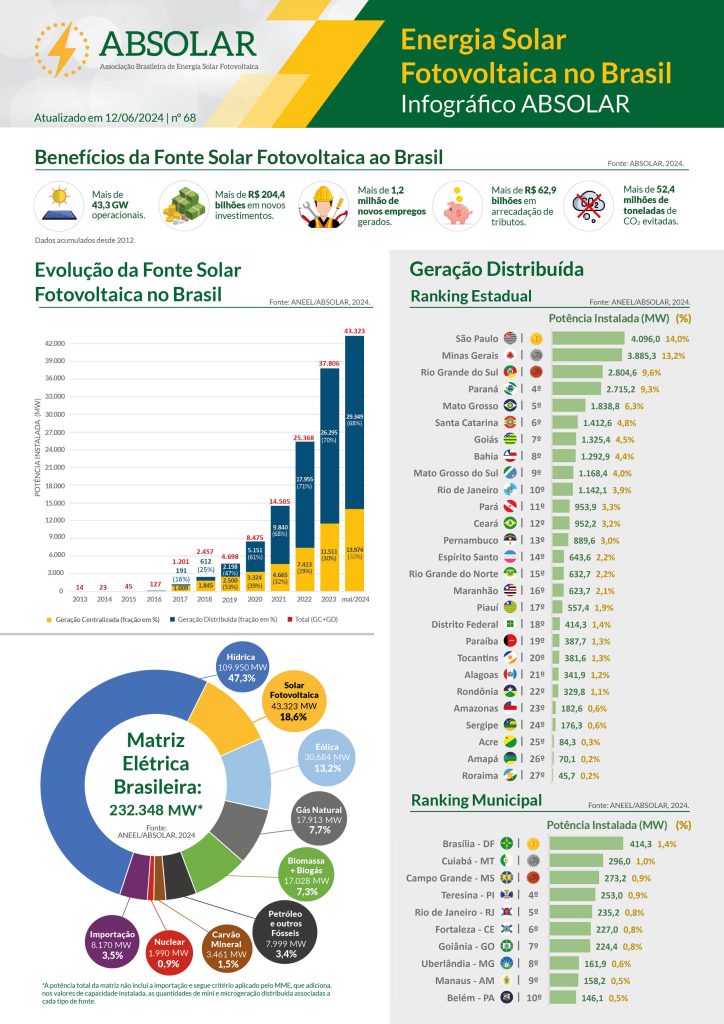
ABSOLAR. Energia solar fotovoltaica no Brasil: infográfico Absolar — junho de 2024. São Paulo: Associação Brasileira de Energia Solar Fotovoltaica, 2024. Disponível em: https://www.absolar.org.br/wp-content/uploads/2024/07/Infografico_junho-724x1024.jpg. Acesso em: 17 jul. 2024.
ANEKE, Mathew; WANG, Meihong. Energy storage technologies and real life applications—a state of the art review. Applied Energy, v. 179, p. 350-377, 2016.
BAPTISTA, David Felice Falivene. Direito da energia elétrica: uma proposta de regulação para microrredes. Tese (doutorado em energia elétrica) — Faculdade de Engenharia Elétrica e de Computação, Universidade Estadual de Campinas, Campinas, 2024.
BAPTISTA, David Felice Falivene; SILVA, Luiz Carlos P. da; FONSECA, Isabel Celeste. A natureza jurídica da geração distribuída de energia elétrica no Brasil. Revista Direito Público, v. 19, n. 104, 2022. Disponível em: https://www.portaldeperiodicos.idp.edu.br/direitopublico/article/view/6956. Acesso em: 22 fev. 2025.
BARBOUR, Edward; WILSON, I. A. Grant; RADCLIFFE, Jonathan; DING, Yulong; LI, Yongliang. A review of pumped hydro energy storage development in significant international electricity markets. Renewable and Sustainable Energy Reviews, p. 421-432, 2016. DOI: 10.1016/j.rser.2016.04.019.
BARRÉ, Anthony et al. A review on lithium-ion battery ageing mechanisms and estimations for automotive applications. Journal of Power Sources, v. 241, p. 680-689, 2013.
BEARD, K. W. Linden‘s handbook of batteries. 5. ed. McGraw Hill, 2019.
BRADSHAW, Michael J. Global energy dilemmas: a geographical perspective. Geographical Journal, v. 176, n. 4, p. 275-290, 2010.
CARVALHO, Priscila; SPATARU, Catalina; SERRÃO, André. Electricity markets and regulatory developments for storage in Brazil. In: LETCHER, Trevor. Storing energy. Elsevier, 2022. p. 811-830.
CHEN, Haisheng et al. Progress in electrical energy storage system: a critical review. Progress in Natural Science, v. 19, n. 3, p. 291-312, 2019.
DENHOLM, P.; HAND, M. Grid flexibility and storage required to achieve very high penetration of variable renewable electricity. Energy Policy, v. 39, p. 1.817-1.830, 2011.
DIVYA, Kurthakoti C.; ØSTERGAARD, Jacob. Battery energy storage technology for power systems—an overview. Electric Power Systems Research, v. 79, n. 4, p. 511-520, 2009.
DUNN, Bruce; KAMATH, Haresh; TARASCON, Jean-Marie. Electrical energy storage for the grid: a battery of choices. Science, v. 334, Issue 6058, p. 928-935, 2011.
ECKER, Madeleine et al. Calendar and cycle life study of Li (NiMnCo) O2-based 18650 lithium-ion batteries. Journal of Power Sources, 2014, 248: 839-851.
EMPRESA DE PESQUISA ENERGÉTICA. Balanço energético nacional: relatório síntese 2024. Ano base 2023. Rio de Janeiro: Ministério de Minas e Energia (MME), 2024. Disponível em: https://www.epe.gov.br/sites-pt/publicacoes-dados-abertos/publicacoes/PublicacoesArquivos/publicacao-819/topico-715/BEN_S%C3%ADntese_2024_PT.pdf. Acesso em: 22 fev. 2025.
EUROPEAN COMISSION. COM(2018) 773 final — COMUNICAÇÃO DA COMISSÃO AO PARLAMENTO EUROPEU, AO CONSELHO EUROPEU, AO CONSELHO, AO COMITÉ ECONÓMICO E SOCIAL EUROPEU, AO COMITÉ DAS REGIÕES E AO BANCO EUROPEU DE INVESTIMENTO. Um planeta limpo para todos: estratégia a longo prazo da UE para uma economia próspera, moderna, competitiva e com impacto neutro no clima. Bruxelas: [s.n.], 2018.
EUROPEAN COMMISSION. Commission recommendation of 14 March 2023 on energy storage: underpinning a decarbonised and secure EU energy system 2023/C 103/01. 2023. Disponível em: https://eur-lex.europa.eu/legal-content/EN/TXT/?uri=oj:JOC_2023_103_R_0001. Acesso em: 22 fev. 2025.
EUROPEAN COMMISSION. Commission Staff Working Document. Energy storage—the role of electricity. 2017.
EUROPEAN COMMISSION. The future role and challenges of energy storage. DG ENER Working Paper, 2013. Disponível em: http://ec.europa.eu/energy/infrastructure/doc/energystorage/2013/energy_storage.pdf. Acesso em: 22 fev. 2025.
EUROPEAN COMMISSION. European climate law. 2021. Disponível em: https://climate.ec.europa.eu/eu-action/european-climate-law_en. Acesso em: 22 fev. 2025.
EUROPEAN COMMISSION. Study on energy storage: contribution to the security of the electricity supply in Europe. 2020. Disponível em: https://op.europa.eu/en/publication-detail/-/publication/a6eba083-932e-11ea-aac4-01aa75ed71a1/language-en?WT.mc_id=Searchresult&WT.ria_c=37085&WT.ria_f=3608&WT.ria_ev=search. Acesso em: 22 fev. 2025.
EUROPEAN PARLIAMENT. Energy storage: which market designs and regulatory incentives are needed? Committee on Industry, Research and Energy (Itre), 2015. Disponível em: https://www.europarl.europa.eu/RegData/etudes/STUD/2015/563469/IPOL_STU(2015)563469_EN.pdf. Acesso em: 22 fev. 2025.
FAGUNDES, Maria Aparecida. Os novos rumos do direito da eletricidade. Revista de Direito Administrativo, Rio de Janeiro, v. 224, p. 1-30, 2001.
FERRÃO, P. (Coord.). Armazenamento de Energia em Portugal. Lisboa: Adene — Agência para a Energia, Observatório da Energia, Ciências ULisboa, Técnico Lisboa. Disponível em: https://www.observatoriodaenergia.pt/wp-content/uploads/2021/03/ESTUDO-armazenamento-de-energia_Texto_Final_revisto-OBS-v2.pdf. Acesso em: 22 fev. 2025.
GÖTZ, Manuel et al. Renewable power-to-gas: a technological and economic review. Renewable Energy, v. 85, p. 1.371-1.390, 2016. DOI:10.1016/j.renene.2015.07.066.
HANN, Veryan. Transition to decentralised electricity storage: the complexities of consumer decision-making and cost-benefit analyses. Energy Policy, v. 147, 2020.
INTERNATIONAL ENERGY AGENCY (IEA). Grid-scale storage. 2021. Disponível em: https://www.iea.org/energy-system/electricity/grid-scale-storage. Acesso em: 2 jul. 2024.
INTERNATIONAL HYDROPOWER ASSOCIATION (IHA) et al. Hydropower status report. Londres: International Hydropower Association, 2018.
IRENA. Electricity storage and renewables: costs and markets to 2030. Abu Dhabi: International Renewable Energy Agency, 2017.
KEAR, Gareth; SHAH, Akeel A.; WALSH, Frank C. Development of the all‐vanadium redox flow battery for energy storage: a review of technological, financial and policy aspects. International Journal of Energy Research, v. 36, n. 11, p. 1.105-1.120, 2012.
KOSZOWSKI, Maciej. Analogical reasoning in law. Cambridge Scholars Publishing, 2019.
KREEFT, Gijs; MAUGER, Romain. Developing a regulatory framework for electricity storage. In: ROGGENKAMP, Martha; GRAFF, Kars Jan; FLEMING, Ruven C. Energy law, climate change and the environment. Edward Elgar, 2021. p. 679-693.
LI, Siguang; ZHANG, Chengning. Study on battery management system and lithium-ion battery. In: 2009 INTERNATIONAL CONFERENCE ON COMPUTER AND AUTOMATION ENGINEERING. IEEE, 2009, Bangkok. p. 218-222.
LOVINS, Amory. Reinventing fire: bold business solutions for the new energy era. Chelsea: Green Publishing, 2013.
LUND, Henrik; ØSTERGAARD, Poul Alberg; CONNOLLY, David; MATHIESEN, Brian Vad. Smart energy and smart energy systems. Energy, v. 137, p. 556-565, 2017. DOI: 10.1016/j.energy.2017.05.123.
MELLO, C. A. B. Curso de direito administrativo. 35. ed. São Paulo: Malheiros Editores, 2021.
PARRA, David; MAUGER, Romain. A new dawn for energy storage: an interdisciplinary legal and techno-economic analysis of the new EU legal framework. Energy Policy, v. 171, 113262, 2022.
PIRSTNER-EBNER, Renate. European energy law: market system for electricity and gas-energy supply security-green energy system of the future (green smart grid). Nomos Verlag, 2022. p. 146-149.
POONPUN, Piyasak; JEWELL, Ward T. Analysis of the cost per kilowatt hour to store electricity. Ieee Transactions on Energy Conversion, v. 23, n. 2, p. 529-534, 2008.
RIFKIN, Jeremy. The green new deal: why the fossil fuel civilization will collapse by 2028, and the bold economic plan to save life on earth. Nova York: Macmillan+ ORM, 2019.
SANTOS, Filipe Matias. Tendências recentes do direito administrativo da energia: a regulação das comunidades de energia (e do autoconsumo coletivo) e a descarbonização do setor do gás natural. e-Pública, Lisboa, v. 8, n. 1, p. 271-283, abr. 2021.SILVA, J. A. Curso de direito constitucional positivo. 45. ed. São Paulo: Malheiros Editores, 2024.
SOARES, Ian Varela; MAUGER, Romain; SANTOS, Thauan. Considerations for benefit stacking policies in the EU electricity storage market. Energy Policy, v. 172, 2023.
TÁCITO, Caio. Produtor independente de energia elétrica. Revista de Direito Administrativo, Rio de Janeiro, v. 242, p. 183-186, 2005.
WENNERSTEN, Ronald; SUN, Qie; LI, Hailong. The future potential for carbon capture and storage in climate change mitigation—an overview from perspectives of technology, economy and risk. Journal of Cleaner Production, v. 103, p. 724-736, 2015.
ZAKERI, Behnam; SYRI, Sanna. Electrical energy storage systems: a comparative life cycle cost analysis. Renewable and Sustainable Energy Reviews, v. 42(C), p. 569-596, 2015.